
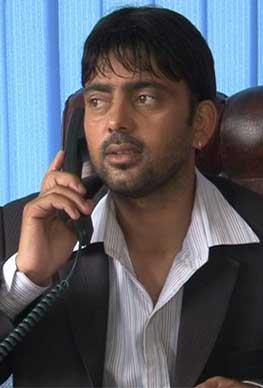
Biography
Rishi Raj Acharya is a renowned movie director. He has filled the canvas of Nepali cinema with the sensitivity of society and the depth of creative perspective. He does not confine cinema to only entertainment, he understands it as a medium of social awareness, a platform for cultural promotion, and a reflection of self-experience.
Summary of this Profile
| Name | Rishi Raj Acharya |
|---|---|
| Birth Date | September 14 1978 |
| Birth Place | Dang |
| Current Address | Kathmandu |
| Blood Group | O+ |
| Marital Status | Married |
| Nationality | Nepali |
| Education | Master |
| rbmovies18@gmail.com | |
| Involvement Organizations | Film Director's Guild of Nepal, Film Artist Worker's Organization Of Nepal (Fawon) |
Acharya was born on September 14, 1978, in Tulsipur Sub-Metropolitan City of Dang district. Born into a middle-class family, his childhood passed in a simple and ordinary way. He completed his school education at the local Janata Sanskrit Secondary School.
Acharya still clearly remembers watching the first movie of his life, 'Maya Preeti', when he was in Class 4. The movie left a deep impact on his young mind. After watching it, he became attracted to acting. In 1994, while studying in Class 7, he came to Kathmandu carrying the dream of becoming an actor. Somehow, he got the chance to meet a few filmmakers. But those directors advised him that it was not yet the right time to become an actor and suggested that he first complete his studies. Carrying a heavy heart from not being able to become an actor, he returned to Dang. He believed that he could become an actor after finishing his education. So, he studied diligently.
In 1997, he passed the SLC exam. Then, in 1999, he completed the Proficiency Certificate Level (PCL) from Palpa Multiple Campus, Palpa. After that, he moved to Kathmandu and began studying sociology at Tri-Chandra College. In 2011, he completed a master’s degree in the same subject.
The first movie he watched became a window through which he saw the world of art, where he began to understand emotions, creativity, and the stories of society. Believing that the stories of society should be told through art, he chose to study sociology. For him, studying sociology became a deep preparation to understand society, to turn its context into stories, and to bring those stories to the screen.
Carrying the dream of becoming an actor, Acharya started looking for acting opportunities after arriving in Kathmandu. After meeting many directors, in 2000 he got the opportunity to act in the famous comedy television series 'Hijo Aajka Kura', directed by Santosh Pant. He acted in 15 episodes of this series. After that, in 2002, he acted in another television series 'Phu Mantar', directed by Mohan Mishra. He acted in 10 episodes of this series. Even while enjoying acting, a question kept running in his mind, ‘Where is society in telefilms?’
Around 2004, Acharya met director Shambhu Pradhan. He had gone to act in one of Pradhan's telefilms. There, Acharya shared his thoughts with Pradhan about how to reflect society in telefilms. He expressed his view that 'Cinema should speak of society and reflect culture and heritage.' Pradhan was impressed by his thoughts. So, Pradhan proposed that Acharya work not as an actor but as his assistant director. He gave Acharya a scene and asked him to translate it into visual language. Acharya happily accepted the task, and Pradhan liked his work. From then on, Acharya's journey shifted from actor to assistant director.
Working with Pradhan as an assistant and chief assistant director, Acharya learned the internal structure of television series, scene planning, and emotional balance. From 2008 A.D. onwards, he became a full-fledged director. The television series 'Mamta', directed by him, began airing on Terai Television. After that, he directed 'Aaphanta' in 2009, 'Yatra Jindagiko' and 'Jhatka' in 2010, 'Sanjeevani' in 2011, and 'Bishwas' in 2012. In these series, he not only directed but also acted in some of them.
In 2013 A.D., he began his journey into feature films. In 2014, his first film as a director 'Mistake' was released. That film gave Acharya a new identity. After the success of 'Mistake', he directed 'Sapana Timro Mero', 'Suntalilai Bhagailagyo Jhikley', 'Dream Girl', 'Churifuri', and 'Draupadi'. Acharya believes cinema is not just for entertainment but also plays an important role in transforming society. His films aim to reflect that social reality.
Acharya also directed the short films 'Nasha' and 'Rise'. For 'Nasha', he received the Best Director award at the PIM Nepal Film Festival 2020, and for Rise, he received the Best Director award at the Nepal Africa Film Festival (NAFF) 2022. Likewise, he won the Best Director award at the Quality Entertainment Awards 2021 for the feature film 'Dream Girl', and received several awards at various national and international film festivals for the feature film 'Draupadi'.
Apart from film direction, he has also directed some commercial advertisements and music videos.
In 2008, he established 'RB Movies'. Through RB Movies, he has been providing acting training along with film production. Many of the artists he has trained are making a strong presence in the Nepali film industry today.
Recognizing his expertise in films, the Government of Nepal appointed him as a member of the Film Censor Board. In the Censor Board, he has already completed his two-year term from 2022 to 2024. Likewise, during the same period, he also worked as a member of the Film Exhibition and Monitoring Committee under the Film Development Board.
Institutionally, he is the Senior Vice President of the Film Artist Worker's Organization of Nepal (FAWON), a Lifetime Member of the Film Directors Guild and the Global Actors Federation, and an active member of the Nepal Film Producers Association.
Similarly, he also contributed as a judge in the National Box Office Short Film Award 2021 and Mrs. Nepal Glam 2021.
In recognition of his long-time contribution to the development of Nepali film, he has been honored by various organizations. He has received the Special Contribution Honor from the Film Development Board and has also been honored by organizations such as the Nepal Democratic Sports Union, Ribbon Entertainment, Rapati Samaj Kathmandu, and the Film Journalist Association Dang Chapter.
New Releases (Poush 4)
-
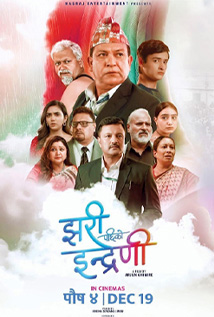
Jhari Pachhi Ko Indreni
Director : Arjun Ghimire
Casts : Ganesh Upreti, Ramesh Upreti, Priyana Acharya, Arjun Ghimire, Prakash Ghimire
Next Releases (Poush 10)
-
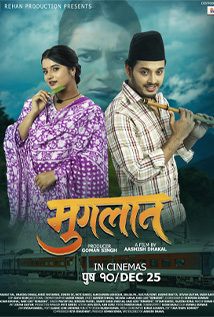
Muglan
Director : Aashish Dhakal
Casts : Prabhat Pal, Smarika Dhakal, Shree Shivanshi, Dinesh D.C., Moti Subedi -

The Blue Light
Director : B.C Gatsby
Casts : Benisha Hamal, Shristi Shrestha, Mahesh Tripathi, Arpan Thapa, Ayushman Desraj Joshi